




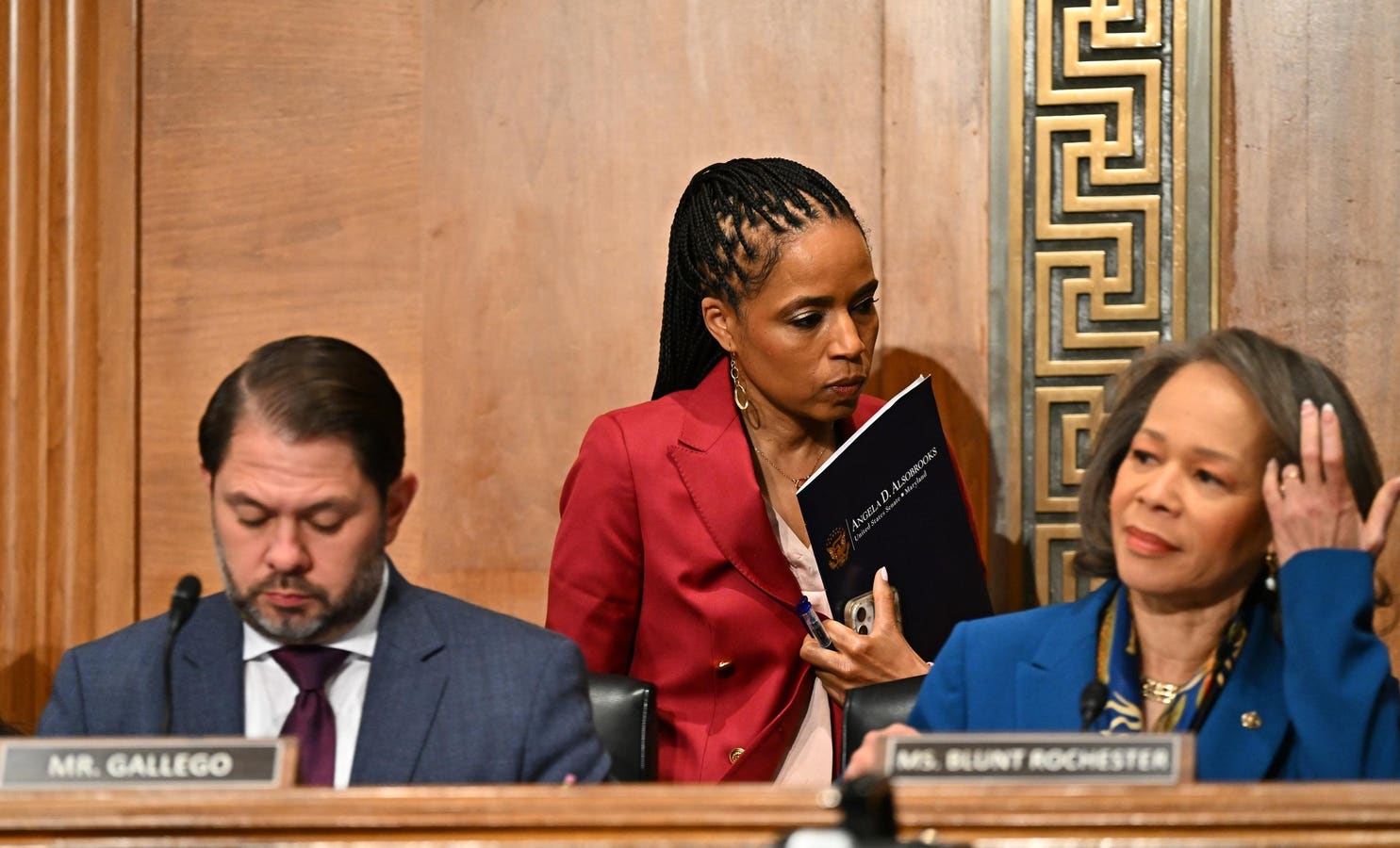
Senator Ruben Gallego, a Democrat from Arizona, from left, Senator Angela Alsobrooks, a Democrat from Maryland, and Senator Lisa Blunt Rochester, a Democrat from Delaware, during a Senate Banking, Housing, and Urban Affairs Committee confirmation hearing in Washington, DC, US, on Tuesday, April 21, 2026. Photographer: Graeme Sloan/Bloomberg
© 2026 Bloomberg Finance LP
Democrats and Republicans across both chambers in Congress are ready to advance passage of crypto market structure legislation, known as Clarity. As with all previous landmark bills, compromise on contentious open issues, or lack thereof, is what can kill or fuel the legislative cycle.
In the case of Clarity, it has been a bumpy road.
Back in January, Coinbase CEO Brian Armstrong abruptly torpedoed a bipartisan agreement and vote of the Senate Banking Committee Clarity bill. The legislation has not been adequately revived since that surprising move.
Racing Against The Congressional Clock
It would take another four months for the Committee to get a vote on the Congressional calendar. That greenlight came about as a result of a bipartisan compromise on yield negotiated by U.S. Senators Angela Alsobrooks (MD) and Thom Tillis (NC).
A positive development, except, by then ethics provisions became a significant non-negotiable for Democrats. Ultimately, the committee advanced the bill in May with the support of just two Democratic Senators, Alsobrooks and Ruben Gallego (AZ). Both made it clear that ethics considerations would decide their next vote.
A statement by Senator Alsobrooks laid out her terms.
“I’ve worked to make this bill better. Let me be very clear: my vote today is a vote to keep working in good faith. It does not mean I will be voting for the passage of the CLARITY Act on the floor. We still have work to do.”
Senator Gallego (AZ) shared similar sentiments.
“My vote today is so we can continue these efforts. But I want to be clear: my vote here does not guarantee a vote on the floor. We have many outstanding issues still to resolve. Toughest and most critical of all is coming to an agreement on ethics guardrails for elected officials.”
The absence of a deal on ethics also led to the passage of the Senate Agriculture Committee Clarity bill on a partisan basis, with no Democratic votes.
Sen. Cynthia Lummis, R-Wyo., arrives to talk about cryptocurrency and digital asset reporting during a tv news interview at the Capitol in Washington, Tuesday, Aug. 10, 2021. (AP Photo/J. Scott Applewhite)
Copyright 2021 The Associated Press. All rights reserved
Is Compromise On Crypto Policy Possible?
Fast forward to July’s heatwave and Senate Republicans are scrambling to schedule a floor vote. Only now, it is no longer just Democrats requiring ethics provisions. Additionally, the fight over yield has galvanized more GOP champions on the side of big banks, and law enforcement groups are pushing back on developer protections.
Illicit finance and risks to consumers continue to be deep concerns that prompted compelling comments by two high ranking Senators last week.
In a post, Senator Cynthia Lummis (WY) focused on consumer protection provisions.
“We wrote the Clarity Act to give law enforcement more tools, not fewer. The Clarity Act writes real-time interdiction between exchanges and investigators into law, allows illicit funds to be frozen in hours instead of waiting years, and preserves every money-laundering charge investigators already rely on.”
Senator Mark Warner (VA), referencing bad actors, expressed optimism and apprehension during a recent Senate Finance Committee nominations hearing.
“I want this done. I’m tired of being in crypto hell. But we gotta do it in a way that does not make this circumstance worse. I want America to lead in digital assets. If we get this wrong, the ramifications could be huge as well.”
What Is The Congressional Path Forward?
Yes, there is bipartisan consensus around the need for market structure legislation, but compromise, a hallmark of Washington’s legislative system, faces significant headwinds.
Still, momentum is building. The U.S. House Financial Services Committee held a field hearing in New York City on July 17. Senators Lummis and Bernie Moreno (OH) met with White House officials to discuss the bill and explore potential ethics language.
And there is much anticipation about the release of a reconciled version of the Senate Banking and Agriculture bills, which is expected later this week. Though, some lawmakers question whether it can garner enough bipartisan votes. In a media interview last week, Senator Gallego had this to say.
“They’re taking a version of the text to the president with their ethics provisions, not with anything that we agree to as Democrats…At the end of the day, we don’t have strong ethics. I don’t care what the president says. You’re not going to have the Democratic votes.”
From left: Summer Mersinger, CEO, Blockchain Association, Sarah Reilly, Vice President and Senior Tax Counsel, Fidelity Investments, Alison Mangiero, Head of Staking Policy and Industry Affairs, Crypto Council for Innovation, Jason Somensatto, Director of Policy, Coin Center, and Corey Frayer, Director of Investor Protection Consumer Federation of America take their seats at the witness table during a House Ways and Means Oversight Subcommittee hearing on ‘Making America the Crypto Capital of the World: Ensuring Digital Asset Policy Built for the 21st Century’ on Capitol Hill, Wednesday, July 16, 2025, in Washington. (AP Photo/Rod Lamkey, Jr.)
Copyright 2025 The Associated Press. All rights reserved.


